Door Pressure Gauges

Your Worldwide Specialists For
We are the specialists!

Guaranteed accurate readings.

We've been supplying major elevator companies for over 45 years!
Manufactured and protected under the following United States Patent and Trademark Office patent numbers: 3171278, 3352153, 3391574, 3482442, and 3596508.
Made in the USA.

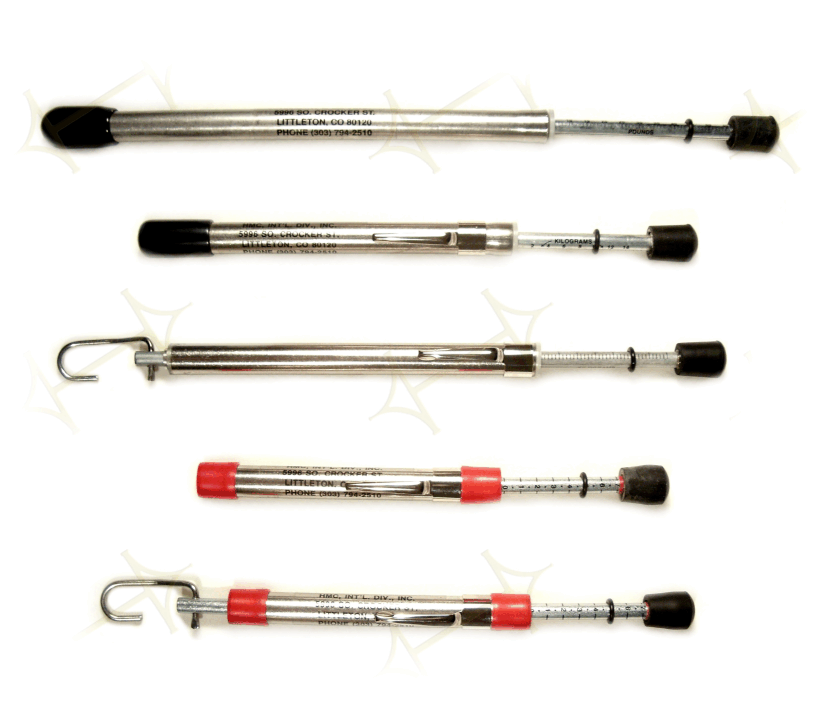
The DPG line of Door Pressure Gauges

DPG-50 DPG U237X DPG-PP U237X-PP
0-50 pound force range


An instrument specifically designed to measure the higher forces typically encountered with elevator doors.

0-35 pound force range


This instrument is capable of measuring the entire range of forces found in servicing interior and exterior doors.

0-7 pound force range


This light duty gauge can be used in determining lower limitations of interior and exterior opening/closing forces.

0-35 pound force range


Push-Pull capability.


This instrument is capable of measuring the entire range of forces found in servicing interior and exterior doors.

0-7 pound force range


Push-Pull capability.


This light duty gauge can be used in determining lower limitations of interior and exterior opening/closing forces.

DPG
Image not to scale
DPG
Image not to scale
U237x
Image not to scale
DPG-push/pull
Image not to scale
U237x-push/pull
Image not to scale


  1. MEET ADA REQUIREMENTS
    The Americans with Disabilities Act requires that both interior and exterior doors of a building be handicapped accessible.

    1. Door Opening Force [4.13.11 ADA Accessibility Guidelines].
      • Exterior hinged doors: (Reserved)
      • Interior hinged doors: 5 lbs (22.2N)
      • Sliding or folding doors: 5 lbs (22.2N)

      NOTE: These forces do not apply to the force required to retract latch bolts or disengage other devices that may hold the door in a closed position.

    2. Automatic Doors and Power-Assisted Doors [4.13.12 ADA Accessibility Guidelines].
      • If an automatic door is used, then it shall comply with ANSI/BHMA A156.10-1985. Slowly opening, low-powered, automatic doors shall comply with ANSI A156.19-1984. Such doors shall not open to back check faster than 3 seconds and shall require no more than 15 lbf (66.6N) to stop door movement. If a power-assisted door is used, its door-opening force shall comply with 4.13.11 and its closing shall conform to the requirements in ANSI A156.19-1984.

  2. SATISFY CODES PERTAINING TO FIRE AND ELEVATOR DOORS
    1. Uniform Building Code #3304 b, d, e, and others.
    2. ANSI Fire Door Code Vol. 6 §2-7.2 and §8-16.
    3. Uniform Fire Code §4.104 and §10.402.


OPERATING INSTRUCTIONS

  1. Set the top (small) o-ring located on the plunger rod on zero, down against the instrument's flange; or set the o-ring on the desired force.
  2. Holding the instrument firmly, press slowly against the door at a point approximately handle-high, and 30 inches away from the door's hinges.
  3. Read the amount of force required to open the door on the plunger scale closest to the bottom of the small o-ring.


We offer secure payment processing for the following credit-cards:

Visa, MasterCard, and Discover accepted — Please call.

For pricing and additional information
Please Contact Us At:

HMC INT'L. DIV., INC.
5996 South Crocker Street
Littleton, Colorado 80120-2054
Phone (303) 794-2510
FAX (303) 794-3703

TOLL FREE 1-888-794-2510

info@hmc-international.com


Click in the image below to
RETURN TO HOME PAGE

Thank You from HMC International

© Copyright, HMC INT'L., MMX
